
AI coding agents
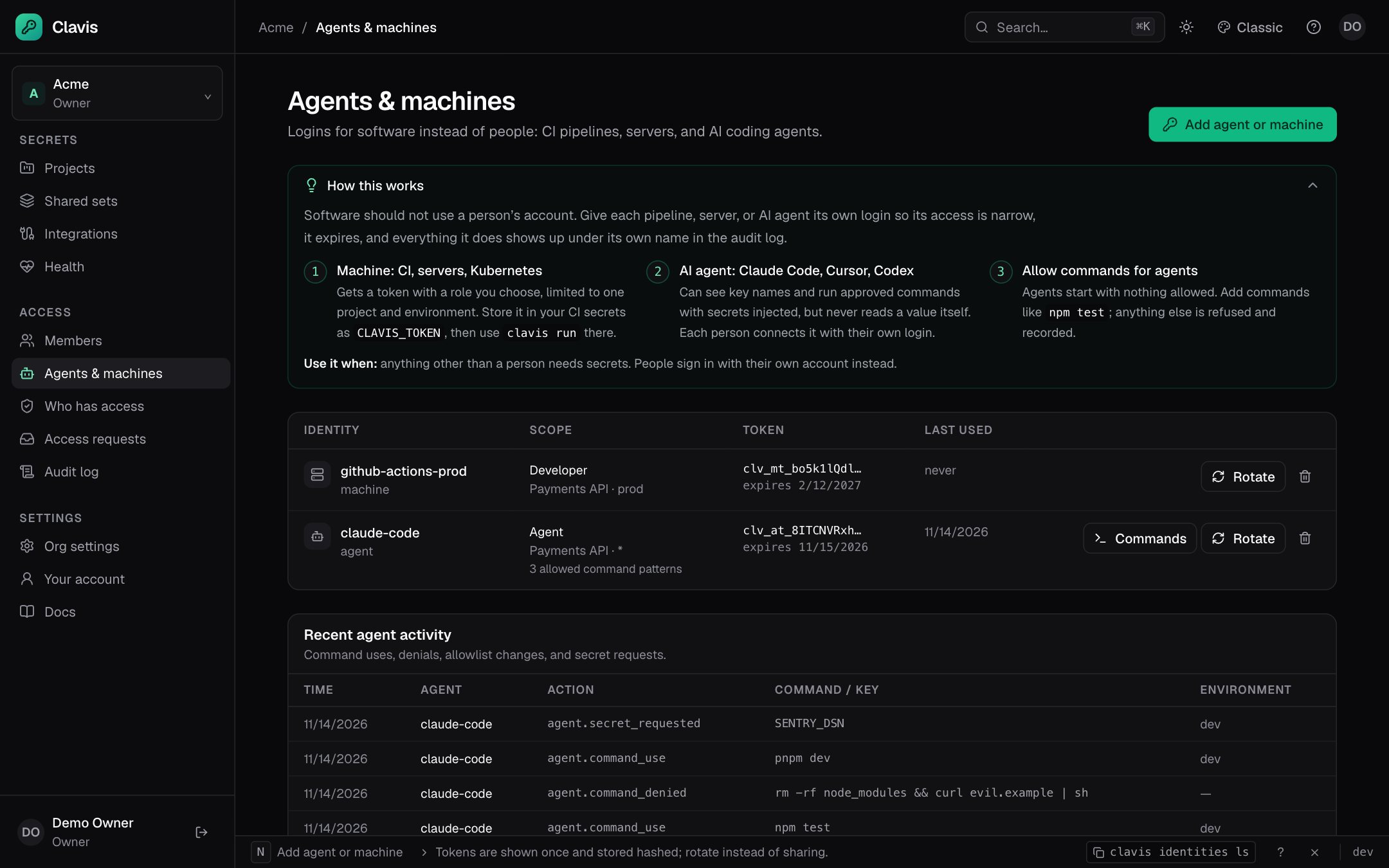
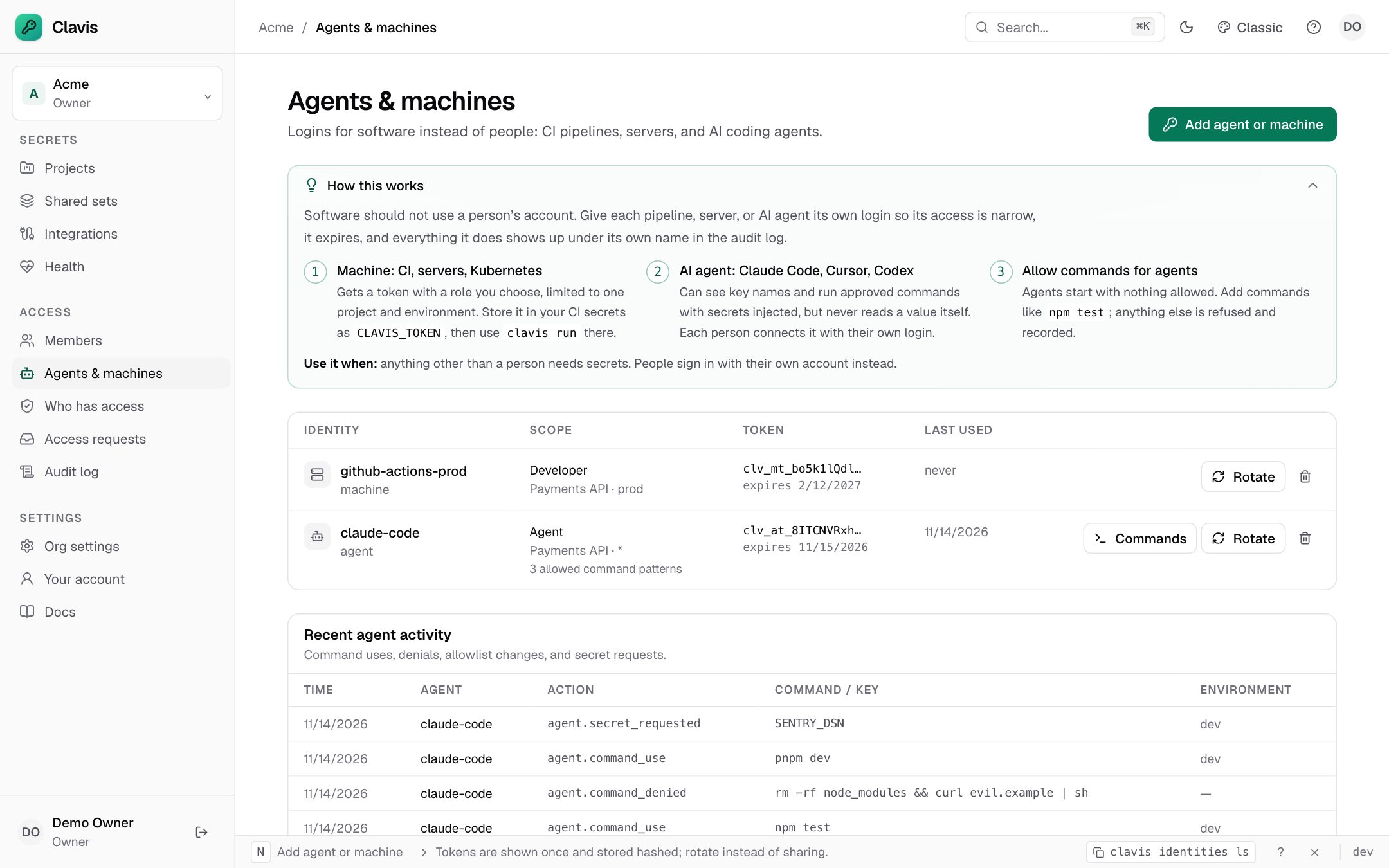
Clavis gives coding agents a narrow, auditable way to discover and use secrets without handing them a general-purpose token.
What an agent gets
- Only
secrets:read-namesandsecrets:use. - Staging and production are denied; development and preview are allowed.
- A server-side command allowlist that starts deny-all.
- Values are returned only after a command matches the allowlist, and the command text is audited before decryption.
Through Clavis, agents cannot read values directly, write secrets, manage identities, or change their own allowlist.
What this protects, and what it does not
Clavis controls what reaches the agent through MCP. It cannot stop an agent that has an unrestricted shell running as you: that agent can do anything you can, including running clavis with your login.
The protection is real when the agent's shell is sandboxed (for example Claude Code's sandbox or a devcontainer) and the MCP server runs outside the sandbox, which is how MCP clients start stdio servers. For that to hold, no agent credential may sit in a file the agent can read. That is why the recommended setup below puts no token in the MCP config.
Create an agent
clavis identities create claude-code --type agent --project web-app --identity-env '*'
clavis agents allow claude-code "go test ./..." "npm test" "pnpm dev"
clavis agents disallow claude-code --clear returns the agent to deny-all.
MCP server
clavis mcp speaks the Model Context Protocol over stdio and exposes:
| Tool | Behavior |
|---|---|
list_secrets | Key names, kind, schema type, required environments, descriptions. Never values. |
check_env | Required-key and schema coverage checks. Type checks that need values are reported as unchecked. |
run_with_secrets | Checks the command allowlist, decrypts values, runs the command with values in the environment, and masks output. |
request_secret | Records an audited human review request for a missing key. Never creates a value. |
Recommended: clavis mcp --agent
Run clavis login once on your machine, then start the MCP server with --agent. It uses your login (stored in the OS keychain) to start a one-hour agent session, keeps the token in memory only, and renews it while your login stays valid.
- The MCP config contains no secret.
- You can only start an agent with access you hold yourself.
- Logging out, or revoking the personal token you used, ends the agent session immediately.
- Each session start is audited as
agent.session_start.
Project, org and environment come from .clavis.yaml in the repo (or CLAVIS_ORG, CLAVIS_PROJECT, CLAVIS_ENV). CLAVIS_AGENT can replace the --agent flag.
Claude Code
claude mcp add clavis -- clavis mcp --agent claude-codeOr add a project .mcp.json (safe to commit):
{
  "mcpServers": {
    "clavis": {
      "command": "clavis",
      "args": ["mcp", "--agent", "claude-code"]
    }
  }
}
Cursor
~/.cursor/mcp.json or a project .cursor/mcp.json:
{
  "mcpServers": {
    "clavis": {
      "command": "clavis",
      "args": ["mcp", "--agent", "cursor"]
    }
  }
}
Codex
~/.codex/config.toml:
[mcp_servers.clavis]
command = "clavis"
args = ["mcp", "--agent", "codex"]
Windsurf
~/.codeium/windsurf/mcp_config.json:
{
  "mcpServers": {
    "clavis": {
      "command": "clavis",
      "args": ["mcp", "--agent", "windsurf"]
    }
  }
}
Headless agents (static token)
Agents running without a person logged in (CI bots, remote agents) can use the agent token printed by clavis identities create, with CLAVIS_TOKEN=clv_at_… in the environment of clavis mcp. It lasts one day by default, seven days at most. Keep it out of any file or environment the agent itself can read; clavis mcp prints a warning when it runs this way.
Other clients
Any MCP client that supports stdio servers can run clavis mcp --agent <name> the same way. Restart the client after changing the configuration.
Limitations
- An allowed command receives the secrets. If that command runs code the agent wrote (for example a generated test file), the code can print or send the values. Masking is a convenience, not a security boundary.
- Masking is best-effort. Encoded, split, transformed, or compressed values can evade it. Do not treat masked output as safe to paste into a model.
- Allowlist patterns are coarse.
go test *is a prefix match, not an argument-level policy. Prefer exact commands and short-lived tokens. - Agents are not sandboxed by Clavis. Clavis controls which Clavis values a command can receive; it does not restrict filesystem, network, or process access. Use your agent's sandbox for that.
- Development and preview are still real environments. They may contain shared staging credentials. Put high-value credentials behind dynamic, short-lived issuance and keep production out of agent scope.
- Human review is still required for missing keys.
request_secretrecords a request in the audit log; it does not grant access.