
Secrets management for humans, machines, and AI agents
One Go binary with an embedded UI. Typed config, dynamic credentials, JIT access, and an auditable path for coding agents. No unseal ceremony, no enterprise edition.
| Key | dev | staging | prod |
|---|---|---|---|
| DATABASE_URL | •••••• | •••••• | •••••• |
| STRIPE_SECRET_KEY | •••••• | •••••• | •••••• |
| REDIS_URL | •••••• | inherits dev | missing |
| LOG_LEVEL | •••••• | •••••• | •••••• |
| FEATURE_FLAGS | •••••• | changed | •••••• |
- FEATURE_FLAGSchanged
- REDIS_URLadded
- LOG_LEVELunchanged
One binary for every secret your apps, pipelines, and agents touch.
Secrets, typed configuration, dynamic credentials, and access control in one place, with one audit trail for every person, machine, and agent.
› How it worksSecrets management
Every environment side by side, with inheritance, versioning, and a typed contract that tells you what is missing before you deploy.
- Environments + inheritance
Development, staging, production, branch environments, and regional overlays without copy-paste.
› Learn more - Versioning + rollback
Every change is an immutable version. Rollback creates a new one instead of rewriting history.
› Learn more - Promotion + snapshots
Diff two environments, tick the keys to copy, and snapshot the target first. Protected targets wait for approval.
› Learn more
| Key | Type | Development | Staging | Production |
|---|---|---|---|---|
| DATABASE_URL | url | ✓ | ✓ | ✓ |
| STRIPE_SECRET_KEY | string | ✓ | ✓ | ✓ |
| SENTRY_DSN | url | ✓ | ✓ | ✕ |
| LOG_LEVEL | enum | ✓ | ✕ | ✓ |
| REDIS_URL | url | ✓ | ✓ | ✓ |
| FEATURE_FLAGS | json | ✓ | ✓ | ✓ |
| WEBHOOK_SIGNING_KEY | string | ✕ | ✓ | ✓ |
Typed config
Declare types, patterns, enums, and where each key is required. Commit the schema next to your code and let CI reject bad values.
- Types + patterns
url, int, bool, json, enum, and regular expressions, per key and per environment type.
› Learn more - Generated loaders
zod for TypeScript, a struct for Go, pydantic for Python. Your app fails fast on bad config.
› Learn more - CI gate
clavis check exits 6 on any missing or invalid value, so drift never reaches production.
› Learn more
LOG_LEVEL:
  type: enum
  values: [debug, info, warn, error]
  required: { production: true }
SENTRY_DSN:
  type: url
  pattern: ^https://.+@sentry\.io/\d+$
  required: { staging: true, production: true }
PORT:
  kind: variable
  type: int
- ✓DATABASE_URLurl
- ✓PORTint
- ✕SENTRY_DSNmissing
- ✕LOG_LEVEL"verbose" not allowed
Access + dynamic secrets
Grant access for an hour, not forever. Issue database and cloud credentials that expire on their own.
- JIT access + approvals
Request a role for a limited time with a reason. An Admin or Owner approves, and it is all audited.
› Learn more - Dynamic credentials
Short-lived PostgreSQL roles and AWS STS credentials that renew, expire, and revoke when a command exits.
› Learn more - Rotation + expiry
Rotation schedules, expiry reminders, and health findings for stale or weak secrets.
› Learn more
“Incident #412: rotate the leaked webhook key.”
- pg-readonly · v-ci-7f3a42m left
- aws-sts · deploy-bot12m left
- pg-migrate · v-ada-19c2revoked on exit
Agents shouldn’t see your secrets.
Let them use secrets without reading them.
› Agent setupEach agent has its own identity and only runs the exact commands you allow. Production is out of scope.
MCP tools list key names and run commands. No tool returns a value, and output is masked.
The command text is written to the audit chain before any value is decrypted, allowed or denied.
Clavis protects what reaches the agent through MCP; pair it with your agent’s sandbox. What this does not protect →
From laptop to production, one CLI
The same binary runs the server and the CLI, so the commands you use locally are the ones CI and agents use.
Sign in once, link the repo, and run any command with values in its environment. Output is masked, and --watch restarts the process when a secret changes.
› Read the guideA UI that explains itself
Real screens from a demo instance, in whichever theme you are reading this.
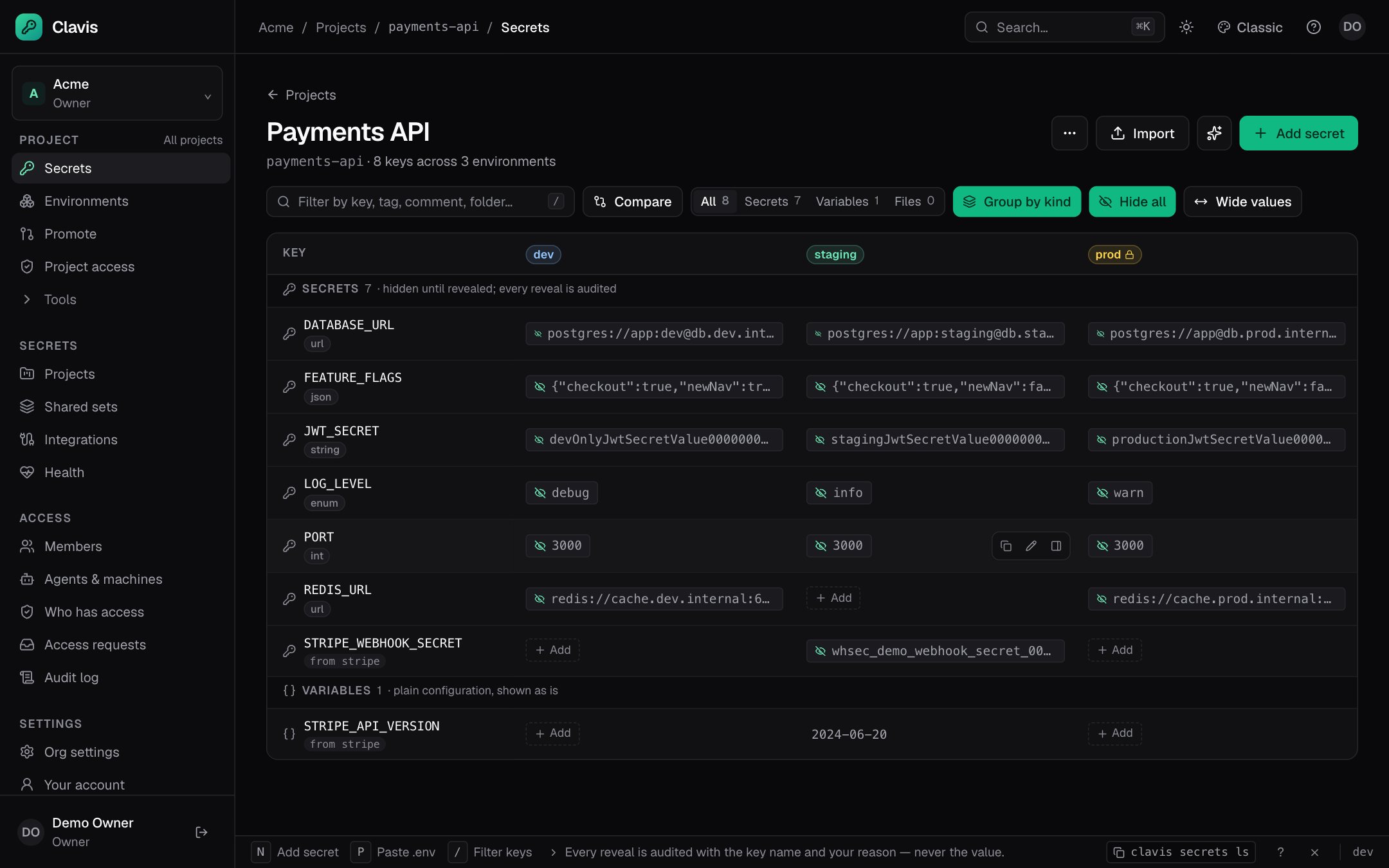
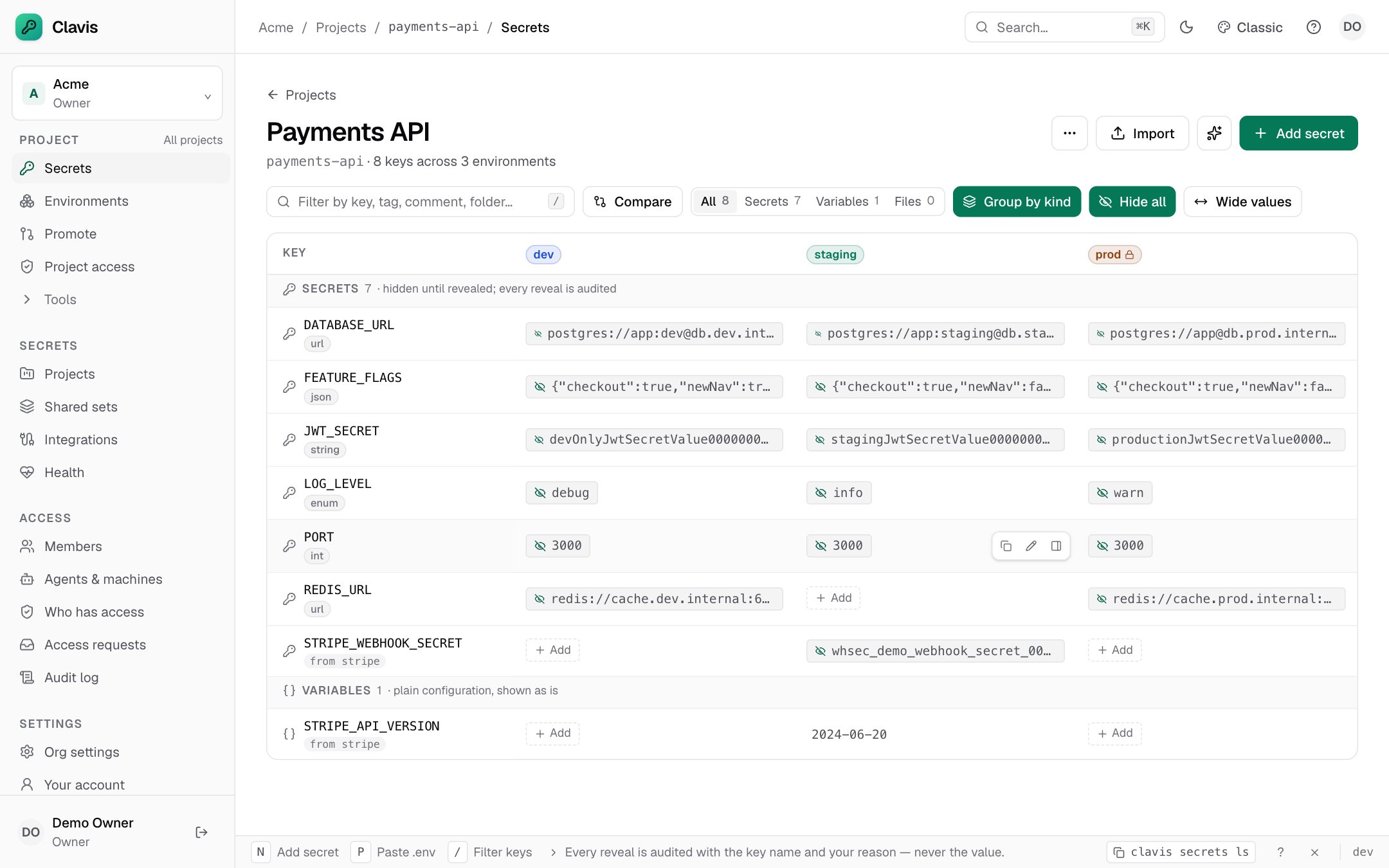
Every environment side by side; each reveal is audited with a reason. See every screen →
Everything included. No paid tier.
SSO, RBAC, approvals, rotation, and dynamic secrets ship in the same Apache-2.0 build as everything else.
How Clavis compares
From each vendor’s public pricing and docs, checked November 2026. “Paid” and “Enterprise” mean the feature exists but not on the free plan.
| Clavis | Vault | Infisical | Doppler | |
|---|---|---|---|---|
| License | Apache-2.0 | BSL 1.1 | MIT core + paid | Proprietary |
| Self-hosting | ✓ | ✓ | ✓ | Enterprise |
| Single binary with embedded UI | ✓ | ✓ | ✕ | ✕ |
| SSO and RBAC | ✓ | ✓ | Paid | Paid |
| Dynamic database and cloud credentials | ✓ | ✓ | Paid | Enterprise |
| Time-limited access and approvals | ✓ | Enterprise | Paid | Paid |
| Typed schema | ✓ | ✕ | ✕ | Value types |
| Generated typed config loaders | ✓ | ✕ | ✕ | ✕ |
| MCP server | ✓ | Beta | ✓ | ✓ |
| Agents run commands without seeing values | ✓ | ✕ | Separate product | ✕ |
| Expiring share links | ✓ | ✕ | ✓ | ✓ |
Security you can inspect
The design and threat model are public, and every claim links to code or docs.
- Envelope encryptionValues are encrypted with a per-project key before they reach the database.
- Separate root keyAWS KMS, GCP KMS, a 0600 file, or Shamir shares — never next to the data.
- Default-deny routesEvery API route declares the permission it needs; undeclared routes fail closed.
- Signed, reproducible releasescosign keyless signatures, SBOMs, and builds you can reproduce byte for byte.
Running in five minutes
SQLite by default and a browser setup wizard. Add PostgreSQL, KMS, and SSO when you need them.
- Start the binaryClavis prints a one-time setup token and writes it to the data directory.
- Claim the instancePaste the token, create the owner account and organization. Setup then closes for good.
- Run your appInstall the CLI, sign in once, link the repo, and use
clavis run.
Questions, answered
Can’t find yours? Ask in GitHub Discussions.
Is Clavis really free? What is the catch?
Everything is Apache-2.0, including SSO, RBAC, approvals, rotation, dynamic secrets, and agent features. There is no enterprise edition and no feature is held back for a paid tier. The project is funded through sponsorships and optional paid support, kept separate from the code. Sustainability policy →
How is Clavis different from HashiCorp Vault or OpenBao?
Vault is a general-purpose security toolkit with a large plugin ecosystem. Clavis focuses on application secrets: one binary with an embedded UI, a setup wizard instead of an unseal ceremony by default, typed config with codegen, environment promotion, and a safe path for AI agents. If you need Vault’s PKI or transit engines, keep Vault; Clavis can sync to it. Migrating from Vault →
Can AI coding agents see my secret values?
Not through Clavis. Agents get their own identity with read-names and use only, a deny-all command allowlist, and MCP tools that never return values. An allowed command does receive the secrets in its environment, so pair Clavis with your agent’s sandbox and keep production out of agent scope. What this protects, and what it does not →
What happens if I lose the root key?
Encrypted values cannot be recovered without it, which is the point of keeping it separate from the database. Back it up apart from database backups, or keep it in AWS KMS or GCP KMS, or split it into Shamir shares held by different people. Self-hosting guide →
Which database do I need?
None to start: Clavis uses an embedded SQLite database by default. Switch to PostgreSQL when you want high availability or several server replicas. Self-hosting guide →
Can I migrate from Infisical, Doppler, Vault, or .env files?
Yes. clavis import reads from Infisical, Doppler, Vault and OpenBao, 1Password Connect, AWS Secrets Manager, GCP Secret Manager, and .env files. Every import supports a dry run, and the source stays readable until you cut over. Migration guides →
Does it work with Kubernetes?
Yes. There is an operator with a ClavisSecret custom resource, a Secrets Store CSI driver that mounts secrets as files, and a webhook provider for External Secrets Operator.
Is Clavis ready for production?
The feature set for 1.0 is complete and the project is in its pre-release hardening phase: security review, load testing, and release verification. Follow the releases on GitHub and read the security design before relying on it for critical systems. Roadmap →